Secrets Of Mosfet Cross Reference and Replacement Guide
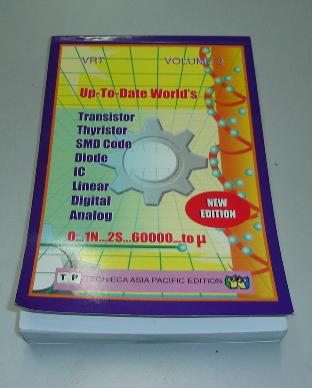
A Semiconductor Replacement Guide Searching for the right mosfet cross reference or datasheet, one has to look for a semiconductor transistor replacement data book and not the Philip ECG master replacement guide. Almost all the transistor replacement book will published out the specification of a particular components such as type of component it belong whether it is a fet, scr, bipolar transistor, horizontal output transistor and also the voltage, ampere, wattage, ohm, frequency and suggested substitution part number. From my experienced, the substitution part number that was recommended by the data book is not always 100 % match. If you have the time, I would like to suggest to you that, find the right part number by yourself rather than depending on the transistor data book.
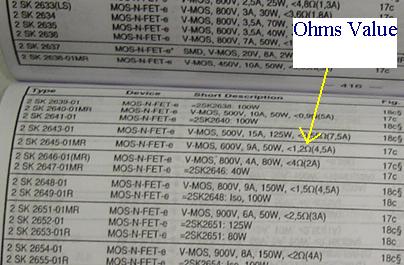
It is the same when you look for horizontal output transistor (HOT) specification which doesn't mean that the bigger specification, the better the substitution part number is. In searching for Mosfet cross reference, you have to look at the ohms value which is provided by the transistor data book besides the specification of voltage, ampere and the wattage. The replacement, besides the same or higher in voltage, ampere and wattage, one should also consider the ohms value. The ohms value has to be as close as possible.
Arrow is showing the mosfet ohms value in a transistor substituion book If the original fet part number is 1 ohm then a good replacement mosfet must have the ohm values between of 0.5 to 1.5 ohm. Do not substitute it with a too high or too low ohms value as this will make the mosfet run warmer and eventually blow the mosfet itself. Even though you can get a replacement with a higher voltage, ampere and wattage, if the ohms value is too low or too high, the mosfet will still burnt after on for quite a while.
It runs well for sometimes before it breakdown again. After two weeks the customer brought back the printer with the same complaint which is no power. Upon checking the power side I found the same mosfet gave up again. Substituting with another mosfet part number that have a similar specification especially the ohms value solved the printer no power symptom. Specification with larger voltage, ampere and wattage don’t guarantee that the replacement mosfet will work. So, taking the mosfet ohms value into consideration, you will have a higher chances to repaired the equipment and sometimes the replacement mosfet will also last longer. |
Nace Sp0170 Pdf Today
The Essential Guide to NACE SP0170 (Formerly RP0170): Accessing the PDF and Protecting Welds in Refineries
In the high-stakes world of oil and gas processing, corrosion is the silent enemy. While much attention is given to the corrosion of the pipe wall itself, a more vulnerable area often determines the lifespan of a facility: the weld heat-affected zone (HAZ) and the underlying steel.
The standard outlines several mandatory and recommended procedures to prevent PTA formation or neutralize it before damage occurs:
If you have searched for the term "nace sp0170 pdf" , you are likely looking for the official document, a technical summary, or guidance on how to apply this standard to protect your assets. This article serves as your comprehensive resource. We will explain what NACE SP0170 is, why it is essential, how to obtain the legitimate PDF, and how it differs from other key NACE standards like MR0175/ISO 15156. nace sp0170 pdf
- Scope: Clearly defines when the standard applies (e.g., carbon steel in H₂S-free, sulfur-bearing service above 240°C).
- Weld overlay requirements: Minimum thickness (often 3 mm), coverage (100% of the HAZ plus adjacent base metal), and alloy selection.
- Alternatives to weld overlay: Such as controlled PWHT or using a solid CRA component.
- Fabrication and quality control: Acceptance criteria for overlay, NDT (dye penetrant, UT), and documentation.
- Definitions: Clarifies terms like “sulfidation,” “weld decay,” and “low-temperature sensitization.”
Short story — "NACE SP0170.PDF"
When Maya found the file named NACE_SP0170.pdf buried in the deep folder of the engineering archive, it felt like a relic from another century of corrosion science. She clicked it open out of curiosity more than hope. The first page was crisp and clinical: committee authors, revision dates, an index of test procedures for external cathodic protection systems. But tucked between diagrams and normative text she noticed a yellowed sticky note embedded as an image — a handwritten line: "If you follow this to the letter you'll miss what matters."
Temperature Control: Keeping equipment "hot" (above the water dew point) if it remains unopened can also prevent the reaction. Document Evolution The Essential Guide to NACE SP0170 (Formerly RP0170):
“With a set of SP0170-compliant isolation pads. They’re in the warehouse. Red box, top shelf. They’re fiberglass-reinforced with a 500°F rating. Slide them between the pipe and the saddle. No clamp. No metal-to-metal contact. No galvanic corrosion.”
Environmental Limits: It defines exactly how much chloride, temperature, and H2S a metal can take before it begins to die. Scope: Clearly defines when the standard applies (e
Dave groaned. “That’s the coating standard? For underground piping? What does that have to do with a hot flare line in the air?”
Copyright@ 2006-2014-www.ElectronicRepairGuide.com All Rights Reserved